


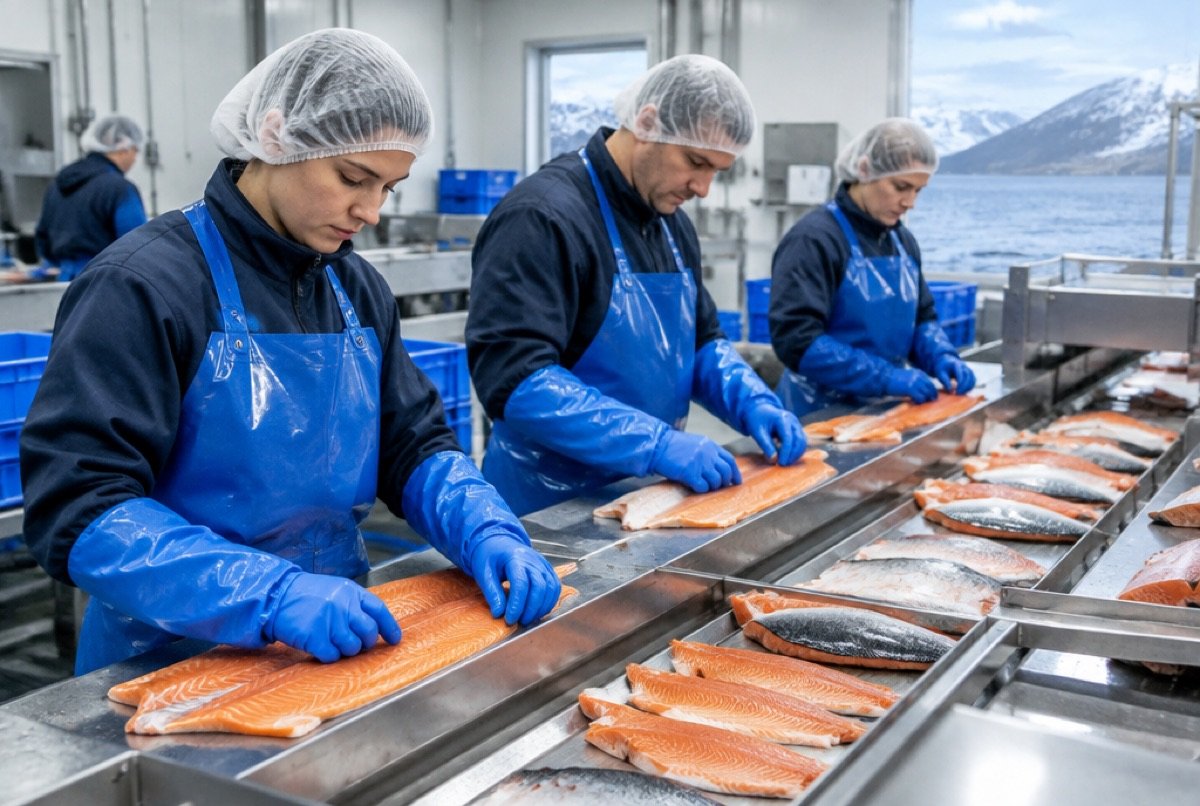
Along the Norwegian coast, thousands of people work in plants that turn fresh salmon, cod and other fish into fillets and packed boxes for export. The work is done on a production line. Staff sort, trim, weigh and pack fish in cold, clean halls, usually standing for most of the shift.
Seafood is one of the biggest export industries in Norway. Salmon plants run through the whole year, while white fish plants in the north get very busy during the winter cod season. Because many plants sit in small coastal towns, employers often look outside the local area for line workers.
Pay in this industry is protected. Norway has no general minimum wage, but fish processing is one of the sectors where a minimum hourly rate applies to every worker by regulation. The rate is updated regularly, and extra pay is added for shift work in many plants.
This guide looks at the tasks, indicative pay for 2026, who can apply, the papers you need and how the permit rules differ for people from inside and outside the European Economic Area. We publish information only. We are not an employer and cannot arrange a job or a permit.
Fish Processing Jobs · Norway 2026
🐟 Fish Processing Work in Norway: Hourly Pay, Seasons and Permit Rules
Line worker · Filleting · Packing roles in Northern Norway, Trøndelag and the west coast
See how to apply, step by step ↓
📋 Quick Job Summary
| Job Title | Fish Processing Worker / Production Line Worker / Packer |
| Industry | Seafood Processing & Aquaculture |
| Location | Norway (Lofoten, Tromsø area, Finnmark, Trøndelag, Møre og Romsdal, Vestland) |
| Experience Required | None for basic line work; filleting skill is an advantage |
| Contract Type | Seasonal, temporary and permanent; mostly full-time shift work |
| Visa Sponsorship | Limited; non-EEA workers need a job offer and a residence permit for work, which is not guaranteed |
💰 Salary & Benefits
| Experience Level | Indicative Monthly Pay (gross) |
|---|---|
| Entry Level (line worker; 0-1 yr) | NOK 35,000 – 39,000/month |
| Experienced (skilled worker, filleter; 2-4 yrs) | NOK 38,000 – 44,000/month |
| Senior (team leader, quality control; 5+ yrs) | NOK 43,000 – 50,000/month |
👔 Top Hiring Employers
- Large salmon farming groups with their own harvesting and processing plants
- White fish landing stations and filleting plants in Northern Norway
- Producers of dried and salted cod (stockfish and clipfish)
- Pelagic plants handling herring and mackerel in the autumn
- Staffing companies that supply line workers to seafood plants
🛠️ A Typical Role Involves
- Sorting fish by size and quality on a moving line
- Gutting, trimming and removing bones by hand or with machines
- Weighing portions and packing them in boxes with ice
- Labelling boxes and stacking them on pallets
- Washing and disinfecting tools, tables and floors
- Following food safety rules and reporting quality problems
✅ Who Can Apply
- Adults aged 18 or above in good health
- People able to stand for long hours in a cold and wet room
- Basic English is usually enough on the line; Norwegian helps for better roles
- Citizens of EU and EEA countries can work in Norway without a work permit
- Citizens of other countries need a concrete job offer and a residence permit for work
📄 Documents Required
- Valid passport or national identity card (EEA citizens)
- CV in English or Norwegian
- Written job offer or employment contract from a Norwegian employer
- Residence permit for work, if you are from outside the EEA
- Norwegian identity number or D-number and a tax deduction card
- Norwegian bank account for salary payment
🎁 Employee Benefits
- Regulated Minimum Hourly Rate
- Holiday Pay on Earnings
- Overtime and Shift Supplements
- Work Clothing and Safety Gear
- Membership of the National Insurance Scheme
- Housing Help from Some Employers
📍 Regional Demand
| Lofoten and Vesterålen | Very high in the winter cod season |
| Troms and Finnmark | High (white fish and salmon) |
| Trøndelag (Frøya, Hitra) | High (salmon, year-round) |
| Møre og Romsdal (Ålesund area) | High (white fish, clipfish, pelagic) |
| Vestland and Rogaland | Moderate to high (salmon) |
📝 How to Apply, Step by Step
- Check your right to work first If you hold an EU or EEA passport, you can apply freely. If not, read the permit rules on the immigration website before you spend time on applications.
- Write a short, honest CV List any factory, food or physical work, your languages and the dates you can start. One page is enough for line work.
- Search the public job portal Use the state job board and the other portals listed below. Useful search words are “fiskeindustri”, “produksjonsmedarbeider” and “fish processing”.
- Apply early for the season Plants in the north often choose winter staff in the autumn. Send your application directly through the advert and reply quickly to emails.
- Read the contract carefully A written contract is required by law. Check the hourly rate, hours per week, contract length and what you will pay for housing.
- Complete permit and registration Non-EEA workers apply for the residence permit before travelling. After arrival, everyone attends an ID check and gets a tax card before the first payday.
🧭 Life and Work in a Norwegian Fish Plant
🗓️ The Seasons of the Industry
Salmon is harvested all year, so salmon plants offer the steadiest work. White fish plants in the north are busiest from about January to April, when large cod arrive near the coast. Herring and mackerel plants peak in autumn.
⏰ Hours and Shifts
The normal working week is 37.5 hours under most agreements, and the law limits ordinary hours to 40. During peak landings, plants may ask for overtime, evenings or weekend shifts. Overtime must be paid with a supplement of at least 40 per cent on top of the normal hourly rate.
🧊 The Working Environment
Processing halls are kept cold to protect the fish, and floors are wet. You will wear waterproof clothing, boots, gloves, a hair net and ear protection. The work is repetitive and fast. Tasks are often rotated to reduce strain.
🏠 Housing and Living Costs
Norway is expensive. Food, rent and transport cost far more than in most countries, so a high wage does not always mean high savings. Some plants rent out simple shared housing. The rules limit how much an employer can deduct, and any deduction must be agreed in writing beforehand.
🧾 Tax and Registration
New arrivals book an ID check and receive an identity number and a tax deduction card. Without a tax card, the employer must deduct tax at 50 per cent. Ask the tax office which tax scheme applies to you.
🛂 Permit Rules for Non-EEA Workers
This is the hardest part. Norway’s main work permit is for skilled workers with vocational training or a degree, and basic line work often does not qualify. A seasonal work permit exists for limited periods. Both need a real job offer with pay at the normal Norwegian level, and approval is never automatic.
❓ Frequently Asked Questions
Do I need experience to work in a fish plant?
Not for basic sorting and packing. Training is given on the line. Hand filleting is a skill, and experienced filleters are paid more.
Is Norwegian language required?
Many plants have international teams and use English on the floor. Norwegian becomes important if you want a team leader or quality control role.
Is there a minimum wage in Norway?
There is no general one, but fish processing has a minimum hourly rate set by regulation. It covers every worker in the sector, including staff hired through agencies.
Can a non-EU citizen get this job easily?
No. It is possible only with a suitable job offer and an approved residence permit. Most line jobs are filled by workers who already have the right to work in the EEA.
How long is a seasonal contract?
Winter cod season contracts usually run for two to four months. Salmon plants more often give longer temporary or permanent contracts.
Does this website give jobs or permits?
No. We share general information. Employers choose their staff, and the Norwegian immigration authorities decide every permit application.
🔗 Official Sources and Job Portals
- UDI — Norwegian Directorate of Immigration →
- Norwegian Labour Inspection Authority →
- Skatteetaten — Norwegian Tax Administration →
- Arbeidsplassen — NAV Public Job Portal →
- EURES — European Job Mobility Portal →
- FINN.no Jobs →
✍️ Conclusion
Fish processing in Norway offers regulated hourly pay and real seasonal demand, but the work is cold, repetitive and often far from big cities. For EEA citizens the route is simple. For everyone else the permit rules are strict, so read the official guidance first, apply only to real employers and never pay for an offer.
